What does “Tailoring Education to the Child” Actually Mean?
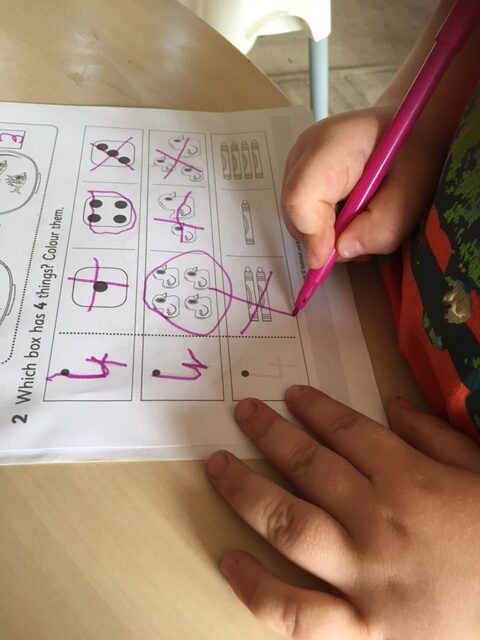
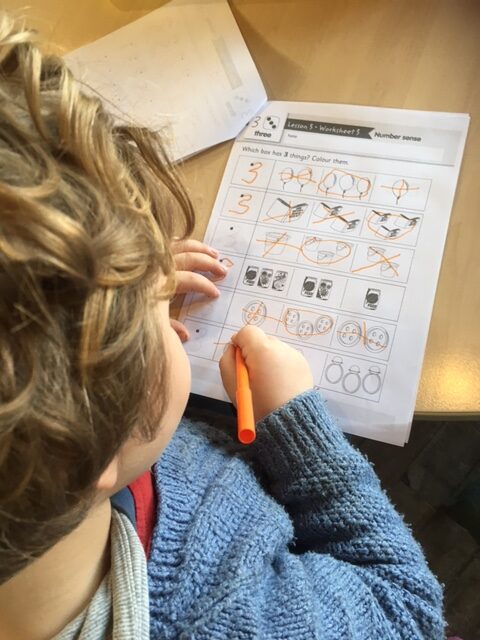
There’s a worksheet on the table. It asks him to colour the correct answer. He circles it instead, and marks the wrong ones with a cross.
According to the worksheet, he’s getting everything wrong. According to the worksheet, he hasn’t done a single question correctly. But watch what he’s actually doing: he’s looking at each number, deciding whether it’s right or wrong, and recording his answer in a way that makes sense to his brain. He’s doing the maths. He just isn’t colouring.
The purpose of the worksheet is number recognition. He’s doing that. The learning objective is met. What isn’t met is the instruction to colour — which is a sub-lesson, not the lesson. In a classroom, a teacher has to hold both things at once, because thirty children learning to follow instructions is as much the point as thirty children learning their numbers. At home, I can separate them. I can praise the maths and teach instruction-following somewhere else — Lego, colour-by-numbers, baking, anything with steps.
That’s tailoring. Not a philosophy. A decision made in the moment because you know this child and you can.
What tailoring actually looks like
It’s not about learning styles in the way the internet tends to mean — visual learner, auditory learner, kinesthetic learner — the research behind it is shakier than it looks — but as a loose starting point for noticing how your child takes in information, it’s more useful than nothing. What it is about is knowing how your particular child engages, where they resist, and what lights something up in them that worksheets might not. (Read: Getting to know your child’s learning style.)
A child who hates worksheets and completes them only reluctantly will learn less from those worksheets than from demonstrating the same knowledge through a conversation, a project, or an essay about something they actually care about. The content is what matters. The vehicle is what you adjust.
Tailoring also means pace. There’s no finishing line to race to. Some children aren’t ready for formal literacy at five — research from countries with later school-starting ages consistently shows that by eleven, there’s no measurable difference in academic achievement between children who began formal learning at different ages. Conversely, a child who wants to push further, faster, can. Neither is wrong. Both are options school can’t easily offer because school has a room full of children the same age, all expected to be in roughly the same place.
What it means when they’re older
Tailoring gets more interesting as they get older, because older learners can be part of the conversation. There’s no reason to wait until they’re sixteen to ask what they’d like to study, or how they’d like to learn it. The more involved a learner is in shaping their own education, the more invested they tend to be in it.
In practice this might look like mixing parent-led sessions with self-directed study, combining subjects they’re drawn to with academic skills they need to build, or using a topic they love — genuinely, however niche — as the vehicle for the skills you’re actually working on. Essay writing via video game history is still essay writing. The academic skill transfers regardless of the subject it’s attached to.
The goal is a learner who understands why they’re learning, feels some ownership over how, and stays connected to the curiosity they started with. Most children arrive with that curiosity intact. The job is not to replace it with a curriculum. It’s to build around it.
The part you can’t plan for
The worksheet moment — the circled answers, the crossed-out wrong ones — I didn’t plan that. I noticed it. I praised the maths and spent extra time colouring with him in a different environment, because at four both skills are equally as important. That’s most of what tailoring is, in the end: noticing what’s actually happening and adjusting to that, rather than to what you expected to be happening.
You’ll miss things. You’ll over-correct sometimes and under-react other times. The advantage you have over a classroom teacher isn’t that you’re better trained. It’s that you have one child in front of you, and you can look at them properly. And if that sometimes feels too much responsibility, being the one who needs to notice, that’s normal too: home-ed parent’ evenings help.