Typing Can Make Writing Easier
and it’s not the lazy option.
One of our home learners was consistently enthusiastic going into lessons and consistently deflated coming out of them. He knew the material — you could tell from conversations, from the way he’d explain things back, from the questions he asked. What he couldn’t do was put it onto paper in a way that reflected what was actually in his head.
It took longer than it should have to figure out why.
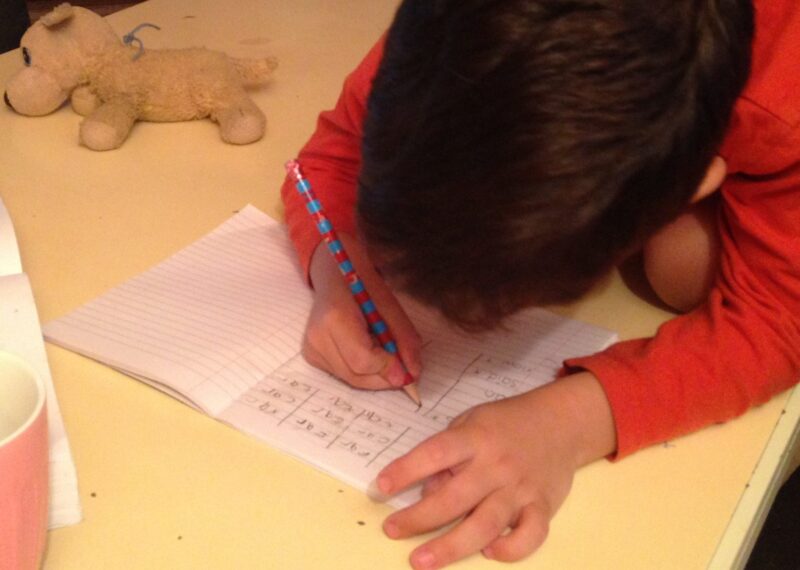
Writing looks like one task. It isn’t. When a child picks up a pen and starts writing, their brain is running two separate processes at the same time: the physical act of forming letters on the page — holding the pen correctly, applying the right pressure, shaping each character — and the cognitive work of choosing words, building sentences, expressing an idea. In fluent adult writers, the first process is so automatic it barely registers. In children who are still developing that muscle memory, it takes real effort. And effort spent on letter formation is effort not available for anything else.
Which means the lesson that was supposed to be about expressing knowledge becomes a lesson about handwriting, whether you planned it that way. The frustration that can cause for the learner can totally derail the lesson, whatever its objective was.
Typing removes the letter formation task entirely. The keyboard handles it. A child who knows where the letters are can put words on a screen with considerably less physical effort than putting them on paper — which means the part of their attention that would have gone on forming letters can go on finding words instead. The writing doesn’t get lazier. Often it gets better: typing can make writing easier.
When typing helps most
This matters for any child who is still working on handwriting fluency, but it’s particularly significant for left-handed learners (for whom the physical mechanics of writing are genuinely more demanding), children with dyslexia, and children who find the motor skill element of writing effortful in a way that doesn’t ease with practice as quickly as it does for others.
It’s also worth considering for any child whose written work consistently underrepresents what you know they understand. If the gap between what they can say aloud and what they can get out on paper is wide and persistent, it’s worth asking whether the medium is getting in the way of the message.
Typing and handwriting aren’t in competition
Offering typing for expression work doesn’t mean abandoning handwriting. The two sit better alongside each other than in opposition. Copy work — asking a child to copy out a passage, a poem, a page from a book they’re enjoying — is one of the most effective ways to build handwriting fluency precisely because it removes the cognitive load of choosing words. They’re focusing only on the formation of letters, which is exactly the practise handwriting needs.
So the split can look like this: typed work for tasks where the lesson objective is expression or knowledge (answering questions, writing essays, book reviews, anything where choosing the words is the point); copy work for deliberate handwriting practice. Each task asks for the skill it’s actually trying to build, instead of asking both at once.
It’s also worth noting that when children are given the choice rather than the default, they sometimes choose the harder option. One day in ten picking up the pen because they want to is more useful than ten days in ten doing it because they have to.
A note on learning to type well
There’s not much point swapping one struggle for another. If typing is going to help ease the pressure on your learner, the learner needs to be reasonably comfortable on a keyboard — not touch-typing at speed, but confident enough that finding the letters isn’t its own effort. Ratatype is a good starting point: it’s a complete typing course that works well as a self-directed home-ed resource, and the process of improving is measurable enough to feel satisfying. The Typing Cat has games that make practice feel less like practice. Both have free tiers that are adequate for home use.
For children who need support with handwriting specifically, Help with Handwriting offers online classes built around short-burst practice and a one-to-one teaching style. If you feel your homeschooler needs extra help outside of what you can give, Help with Handwriting‘s Get Set Write Club might be what you’re looking for.
Parent-teacher
As a parent you know how to encourage your child and we do it without thinking a lot of the time. As your child’s teacher, it helps to be deliberate about that encouragement.
Keeping examples of homeschoolers’ written work to bring out and look at at intervals is a great way to show (and passively continue to remind) homeschoolers how much they’ve progressed. Decorate the fridge with handwriting they’re proud of, make a collage wall of great work in the homeschool classroom, share with family and friends. Let them know that you see their progress as their teacher and that as their parent, you’re cheering them on.