

Even after a decade home educating, I still have homeschool doubt days. Days where I wonder if we’re doing enough, covering enough, if they’re keeping up with their peers – or even if they need to do so. The concept of academic building blocks is what I come back to on those days, to remind myself (and sometimes our homeschoolers themselves) that they’re exactly where they need to be right now. Learning, slowly but surely, with purpose and joy, every day, one single day at a time. Learning doesn’t have an endpoint, and education doesn’t need to be linear.
NB. This post has a newer, fuller version over on the Kitchen Table School Substack, including a free downloadable formula pack to help you implement the formula into your own homeschool.
The beauty of home education from an academic perspective, is the freedom to teach to the child not the age. Home-ed allows you to remove the pressure of academics, which in turn allows you to give your children a bit more freedom in and control of, their education; to give them space and time to discover what it is they like to do and discover what they’re good at.
Education in schools follows a linear path, focused on academics not the child – it has to. There is one teacher to 25+ pupils, and there are academic targets that teacher’s pupils must meet: There is little room for flexibility in either how a subject is taught or when in the school year it’s taught. Home education can offer a young learner flexibility in what, how and when they learn subjects, skills and topics.
If you choose home education for your children, it’s your job to provide access to the resources, teaching and learning opportunities they need to ensure their academic skill set is strong and their knowledge sound, in any core subjects they’ll need (at some point) to take exams in. You also probably want them to enjoy learning, to learn more than just core subjects and to develop skills that can propel them to independence.
It’s also your job, just like any other parent, to help your children explore who they are outside of academics and provide the time, resources, and teaching they need to explore their interests.
Home-ed allows you to take advantage of the extra time gained by not being in school, the flexibility of a homeschool curriculum and the fact you create the ‘school’ timetables to allow your home learners to learn spontaneously.. skipping chapters and swapping books, following interests, chasing up that day’s curiosity.
Not everyone learns at the same pace or at the same time. Home-learning, your child can develop without the (often arbitrary) goal posts of academics + age. You’re able to celebrate their strengths and home-learners need not fear ‘failure’ at skills or subjects they find more challenging. As parent-teacher/ education-facilitator you have the freedom to allocate as much lesson time as is needed to learn a specific task or skill or to skip it entirely – either to come back to at a later date or to replace it with something more worthwhile to the individual learner.
Given time to explore, freedom to learn, and tools to use, every child can succeed at what they’re good at: They just have to find what that is. Home education allows you to help them find it, even if that means academics take a lesser focus.
Our Homeschool Focus
In our homeschool, we have always chosen to prioritise the child over the academics. Numerous studies & the success of education systems in countries such as Finland where students start school at 7, have shown that there is no long-term benefit to forced academics at a young age. Finnish schools prioritise learning through play in the early years and place less emphasis on standardised testing, instead focusing on individual students’ progress.
Likewise, older children who feel the mental health impact of stressful academic pressure conversely do worse post-school than those who achieve lower results yet enjoy learning. Research indicates that students who have felt significant levels of academic stress are more likely to develop anxiety, depression and experience burnout later on in education or upon entering the workforce.
With this in mind, we choose to view education as a series of academic building blocks that do eventually align with peer-based academic targets but without the pressure to achieve specific test-focused goals along the way.
Academic Building Blocks
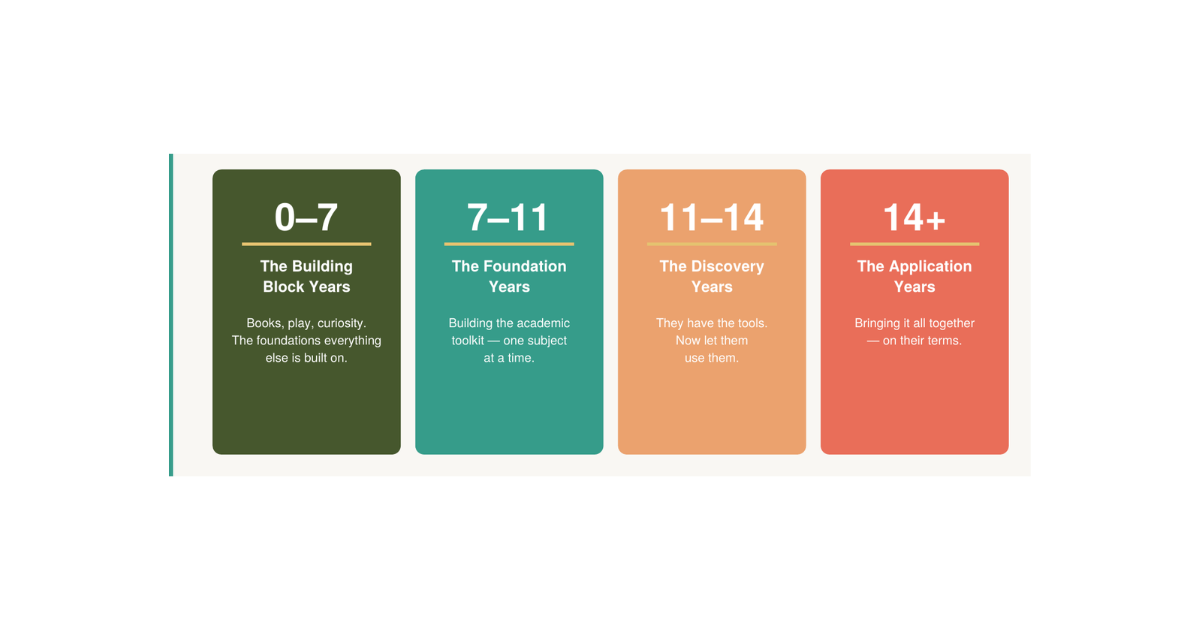
When planning an education pathway for our children, we think of learning as a series of building blocks. First, we start with the basics – the academic equivalent of Duplo and move up slowly, at their pace, to Lego, gradually increasing the complexity of the sets they’re required to build.
0-7 – the building block years
Learning to read and write, basic numeracy, motor skill development, creative exploration and exploring the big world around them.
7-11 – the foundation years
Daily school; building on core academic skill sets – maths, reading and writing, introducing the concept of science as a subject, strengthening general knowledge by expanding their knowledge of the world. Studying a foreign language becomes part of the daily curriculum.
11-14 – the discovery years
Using the academic tools they now have, these are the years to discover what interests them, where their academic strengths lie and to explore the world of knowledge as widely and extensively as possible.
14+ – the application years
When they take the building blocks of their education to date and shape them into tangible knowledge, demonstrable via qualifications, to allow them to follow their chosen path
