Qualification Options for Home-Educated Learners: GCSEs, IGCSEs and the Routes Nobody Tells You About
It’s 10pm on a Tuesday and you have four tabs open: an exam board specification, a spreadsheet you started and abandoned, a forum thread from 2019, and a sixth form’s entry requirements page that wants “five GCSEs at grade 4 or above” from a child who has never sat a formal test in their life. Somewhere around the third tab, the question changed from which exams should we do to have I closed a door I can’t reopen.
You haven’t. Let’s get the short answer out of the way first, because it’s the one you actually came for: home-educated young people take GCSEs, IGCSEs and other qualifications every year, as private candidates, on timetables their families choose — and every route that exists at 16 exists again at 17, 18, 19 and beyond. No door’s slamming shut if you miss the timetable schools use.
N.B. There is also no legal requirement for a home-educated child to sit any qualifications at all. Education must be suitable; it does not have to be certificated. What follows is for families who want exams as part of the plan, not because the law, or anyone else, demands them.
GCSE or IGCSE — what’s the actual difference?
On paper, almost nothing. Both are Level 2 qualifications, both are accepted by colleges, universities and employers, and the Department for Education’s own research found no meaningful difference in difficulty. Which type of GCSE your child takes doesn’t impact their future choices at all.
In practice, for a private candidate, the difference between IGCSEs and GCSEs is everything and it comes down to one word: coursework.
Some GCSE subjects still carry components a school has to supervise, assess or sign off — science practical endorsements, the spoken language endorsement in English Language, non-examined assessment in subjects like art, drama and food. Schools arrange the year around these assessments. A private candidate has to find an exam centre willing to run it, and most can’t or won’t.
IGCSEs (the I stands for international but don’t let that confuse you) are offered by Pearson Edexcel and Cambridge International, and they were built for candidates studying for GCSE exams outside of England/Wales school settings, whether that’s via home-ed or in a different country.
Which means, for the majority of subjects*, assessment is 100% written examination. No coursework, no practicals to authenticate, no endorsements. You study, you turn up, you sit the papers. That’s the whole transaction.
This is why the home-ed world defaults to IGCSE for the sciences, English Language and anything else where the GCSE version drags coursework behind it. It’s not a lesser route or a loophole: it’s the same standard, assessed in a way that doesn’t assume a school is standing behind the child. For subjects with no coursework either way — maths and history are the obvious ones — the choice matters much less, and you can simply pick the specification whose content your child prefers. (Yes, you’re allowed to choose a history syllabus because the topics look more interesting. Encouraged, even. A learner intrigued by the topics is motivated and that counts for more than extra study time.)
A practical bonus worth knowing: IGCSEs typically offer more than one exam sitting per year, which means an early sit, a resit or a staggered plan doesn’t have to wait a full twelve months. Edexcel runs a January series for some subjects, Cambridge a November one.
One note, because it can bite later if you skip it now: always download the actual specification before committing: check the assessment structure, the grading scale (Edexcel IGCSEs use 9–1; some Cambridge syllabuses still use A*–G), and write down the specification code. Future-you will be grateful.
*Languages require a practical assessment, so it’s vital to check the exam centre can facilitate this, and science IGCSE exams may have two options, depending on the board: one which swaps the practical assessment for a written assessment paper, the other with an assessment the centre must facilitate. Check, check and check again before booking the exam.
What if GCSEs aren’t the right fit at all?
Here’s the part the sixth-form entry pages don’t say out loud: GCSEs are one benchmark, not the benchmark.
Functional Skills qualifications in English and maths exist at Entry Level through to Level 2, and Level 2 is treated as broadly equivalent to a GCSE grade 4 by many colleges, apprenticeship providers and employers. They’re shorter, cheaper, focused on practical application rather than literary analysis and algebraic proof, and — usefully — many can be sat on demand, year-round, sometimes online, rather than waiting for a June exam hall. For a young person who finds the full GCSE a wall rather than a gate, Functional Skills can be the same journey via a kinder road.
N.B. “Broadly equivalent” is doing honest work in that sentence. Most further education providers and apprenticeships accept Level 2 Functional Skills; some sixth forms and some university courses specifically want GCSE English and maths and nothing else. If a learner has set their further education sights on a particular destination, check its requirements before choosing this route, not after.
BTECs and other vocational qualifications are assessed continuously — coursework, portfolios, observed practice — which means they generally need enrolment at a college or training provider rather than a kitchen table. That makes them awkward during home education but a completely standard route out of it: many home-educated 16-year-olds go straight into a Level 2 or Level 3 BTEC at college, often studying English and maths alongside if those aren’t banked yet. No GCSEs in hand at 16 does not bar the college door.
How do I register my home-educated child for exams?
This is the bit that looks like a bureaucratic thicket from the outside and turns out to be five phone calls and a form. You cannot enter a candidate directly with an exam board — all entries go through a registered exam centre — so the process runs like this:
Choose the subject, board and specification
and note the specification code (e.g. 4MA1 for Edexcel IGCSE Maths). The centre will ask for it (that’s the ‘don’t let it bite you’ note from before).
Find a centre that accepts private candidates
Some boards publish lists of centres open to external candidates, but local home-ed groups are the goldmine, because they know which centres are genuinely welcoming and which technically-accept-but-sigh. Schools, colleges and dedicated private exam centres all appear on these lists.
Contact centres early — the autumn before a summer sitting is not too soon
Ask about fees, which boards they handle, and whether they can accommodate any access arrangements your child needs. Centres fill up, and not every centre takes every board.
Enter and pay before the deadline
For the May/June series, standard entry deadlines typically fall around February, with increasingly painful late fees after that. Costs vary widely by centre and subject — as a rough planning figure, somewhere between £40 and £200+ per subject once the centre’s admin fee is added, but any numbers you find online (including mine) are guides only: ask the centre to clarify before budgeting.
Sort the practicalities
Photo ID for exam day, the centre’s arrival rules, and if your child needs extra time, rest breaks, a laptop or a separate room, raise it at first contact, not first exam. Access arrangements need evidence and lead time, and centres can only apply for what’s been approved in advance.
N.B. GCSE exams are tracked per student with a UCI (Unique Candidate Identifier) code. This code generates from the first entry and must be supplied for every later entry: think of it like the passport number for exams and keep it somewhere safe.
Results arrive in August for summer sittings, the same day as everyone else’s, and certificates follow from the centre some weeks later. Keep the certificates somewhere you’ll remember and scan them in so you have a digital copy as a backup.
Do all the exams have to happen in one year?
No, and this might be the single biggest structural advantage you have.
A school sits thirty children for nine subjects in one June because it has to; the timetable is the timetable. You are not running a timetable for thirty children. You are running an education for one, and qualifications can be spread across two, three or more years in whatever shape suits the child in front of you.
Two or three subjects a year from around 14 works well for many families: maths and a science one summer, English and a humanity the next, the remainder in a final round. Each subject gets genuine depth instead of a nine-way split of attention, revision season never becomes the annihilating event it is in Year 11, and an early wobble in one subject isn’t a catastrophe because there’s always another sitting.
Three things to hold onto while you plan. First, these are linear qualifications: all papers for a given subject are sat in the same series, so “spreading out” means spreading subjects across years, not papers. Second, if a sixth form or college place at 16 is the goal, check what they want in hand by enrolment versus what can still be in progress — policies genuinely vary and some colleges are happy to take on students who are still actively studying towards GCSEs. Third, there is no upper age limit and no expiry on the plan. A GCSE at 17 is worth exactly what a GCSE at 16 is worth, which is to say: the same certificate, the same grade, the same doors.
That’s not a compromise timetable; it’s what the flexibility of home-ed was for.
Can home-educated young people go to university?
Yes — routinely, and by more roads than the prospectuses advertise. Universities assess home-educated applicants against the same entry criteria as everyone else; what they want is evidence of Level 3 study, and there are several ways to produce it.
A levels as a private candidate. The same machinery as your GCSE plan, one level up. Most A levels are linear and exam-assessed, which suits private candidates. Note though that the sciences carry a practical endorsement that needs a centre able to run it, so the subject-by-subject checking you did at GCSE happens again here. Two or three A levels, sat from home study or with tutor support, is the most conventional route and the one admissions tutors read without blinking.
Sixth form or college at 16. The most common route of all, in practice: home education to 16, then A levels or a Level 3 BTEC in an institution, and a completely standard UCAS application from there.
Access to Higher Education Diplomas. For students 19 and over, a one-year Level 3 diploma designed precisely for people without the traditional paper trail — widely accepted, often with Functional Skills Level 2 satisfying the English and maths entry requirement. If the teenage years produced few certificates, this route effectively resets the board.
The Open University. No entry requirements at all. Some families use OU modules as Level 3 evidence in their own right; some students simply begin their degree there; and completed OU credits can strengthen a later application to a traditional university. For a self-directed home-educated learner, it is often less of a leap than it sounds.
Degree apprenticeships and foundation years round out the picture — the former combining paid work with a funded degree, the latter adding a preparatory year to a standard course for applicants without conventional qualifications.
Two home-ed-specific quirks worth knowing before the UCAS form appears. The application asks for a Unique Learner Number and a school — a private candidate won’t have the first and “home education” needs coaxing into the second, but both are solvable and well-documented in the home ed community. The academic reference UCAS forms ask for needs to come from someone who knows the applicant in an official capacity, rather than a parent. A tutor, an exam centre, an employer, a supervisor from volunteering, even a local authority officer who knows the family. It’s worth cultivating one such relationship a year or so out; it’s the only part of the process that genuinely rewards forward planning.
The honest bit
There will still be a night — probably in February, probably around entry-deadline time — when the spreadsheet is open again and the doubt walks back in. The fees are real, the deadlines are real, and coordinating multiple subjects across two boards and one slightly disorganised exam centre is genuinely tedious. Nobody is going to pretend otherwise, least of all me.
But the doubt is about logistics not about whether the routes exist or if home-education is disadvantaging your kids. The routes exist. Thousands of home-educated young people walk them every year, at 16 and 18 and 23, into colleges and apprenticeships and lecture halls, and the system, for all its forms and fees, receives them exactly as it receives everyone else.
There is no race, and there is no finish line at 16. There are options, a calendar with more dates on it than school ever showed you, and a child who will get there — this June, or next November, or by a road you haven’t found yet.
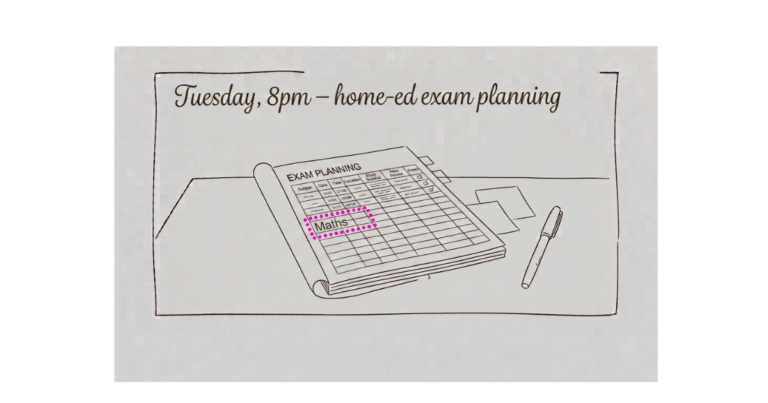
Keeping track of everything is half of the job, which is the point of this free-to-download exam planning spreadsheet/private candidate checklist. Yours to keep (no signup needed), everything you need to remember in one place. Make your own copy, fill in the yellow, and start with the centre — not the revision.
If you’d like the rest of the KTS exam-season guides as they land (access arrangements, choosing a board, the private-candidate timeline), pop your email below. If not, enjoy the planner.
This post is general information, not legal or admissions advice. Exam board policies, fees and entry requirements change; always confirm details with the board, centre or institution directly. Last updated July 2026.