

One of the things that shifts as your home learner gets older is how much of the day they can take responsibility for. A seven-year-old working through a morning of activities needs a very different kind of scaffold than a thirteen-year-old managing a week’s worth of subjects independently. The tool that works for one won’t work for the other, and that’s not a problem, it’s just where they are. Being able to meet your learner where they are, regardless of age, is one of the advantages of home education.
A daily home-ed checklist grows with your child’s ability to study independently. For younger learners, or learners who have never studied outside of a classroom before, it’s a parent-led structure: you fill it in the night before or first thing, they work through it in whatever order suits them. For children who are newer to working independently, it builds the habit of knowing what’s expected and ticking it off — checklists actively support neurodivergent students and give all learners confidence in their ability to manage their own workload: feeling part of the process makes a real difference to how the day runs.
By the teen years, most learners can manage a daily checklist independently, checking in with a parent at key points rather than being guided through each task.
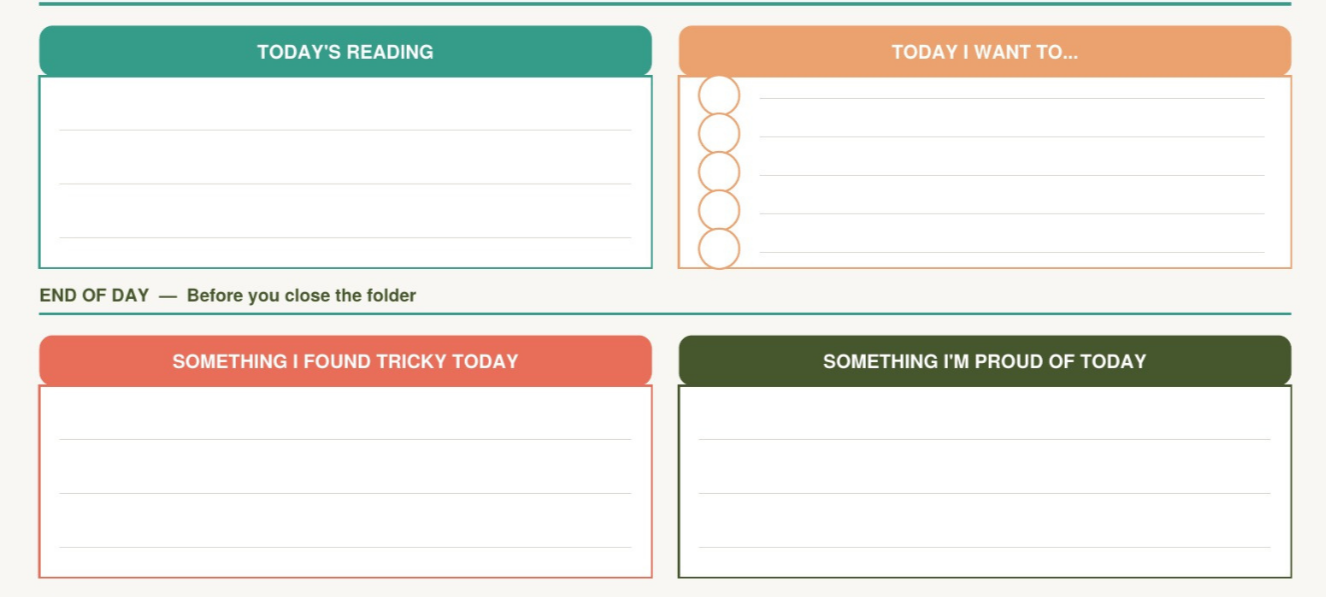
Included in the daily checklist download is a reflection section. It’s useful to fill this in at every stage. A child who can name what they found hard today — and what they’re proud of — is developing something that matters long beyond the worksheet. You could, if your child is interested, ask them to write a weekly reflection as a journal entry. Reflect back on these at the end of the year, allowing them to see how much progress they’ve made with any aspects of home-ed they may have struggled with.
Daily homeschool checklists suit:
- Learners who are new to independent work and need a simple scaffolded system to build the habit
- Younger children who aren’t ready to manage a full week’s workload autonomously
- Weeks when the routine has been disrupted and a full weekly folder feels like too much to hold onto
- Anyone who responds better to “just today” than “by Friday”
Daily checklists can be used alongside a weekly folder if that style of assigning work matches your home-ed prep style. A weekly folder is the same idea as a daily checklist only with more autonomy given to the learner — weekly work is assigned, the learner decides when to complete it and hands it all in for marking on Friday. Same idea, longer horizon, works well once the daily habit is established.
If you want to try weekly folders but aren’t sure how your homeschooler will cope with being assigned a bulk load of work, daily folders + a weekly folder can help them learn to organise those larger assignments into shorter, more manageable chunks. The download for weekly folders is here.
