

One of the tensions that comes with home education — and nobody really warns you about this one — is the autonomy problem. You want your children to have the freedom that home education offers: to sleep, to follow interests, to work at their own pace. And you’re also the person responsible for making sure the work actually gets done. Those two things pull against each other more than you’d expect, especially as they get older and the “must be in at 9am” structure of school is no longer doing any of the heavy lifting for you.
We’ve been home educating for a decade. The thing that helped most with this particular tension wasn’t a stricter timetable or a better curriculum. It was a folder.
What a weekly folder is
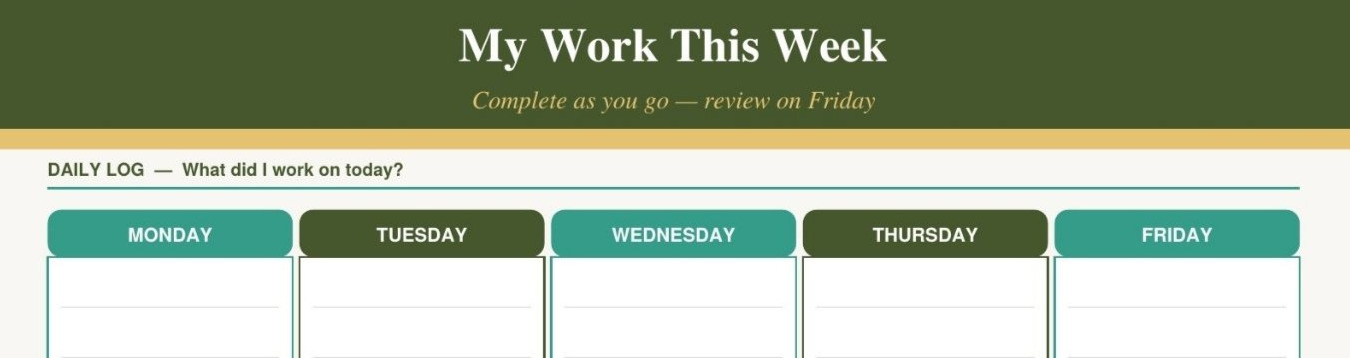
A weekly homeschool folder contains everything a learner needs to complete independently that week: worksheets, writing assignments, reading tasks, puzzles, art projects, revision. The parent-teacher fills it at the start of the week. The learner has until Friday to complete it. What they do on which day, and in what order, is up to them. Kind of like homework, just for the school day.
That’s it. Simple in principle, genuinely useful in practice.
The folder sits alongside lessons rather than replacing them. Think of it like prep time at an independent school: the time is non-negotiable, but how it’s used within that time is the learner’s choice. For home educators managing more than one child, it’s also a tool that makes it possible to teach in the middle. One child can be working independently on folder tasks while you’re working directly with another. You can use middle-ability resources for the lesson at the kitchen table, adding extension tasks to challenge and/or support each student individually in the folders.
Why it works
The folder makes expectations concrete. At the start of the week, the learner can see exactly how much is expected of them and what each task involves. Go through it together on Monday morning, make sure they understand what “fill in the gaps” actually means for each specific worksheet (you’d be surprised), and ask them to sign the to-do list. That last part matters more than it sounds. A signed list isn’t bureaucracy — it’s a small acknowledgement that this is a team effort, and that the work they’ve agreed to do is theirs to complete.
For learners who resist structure, especially those for whom PDA is part of the picture, the folder shifts the dynamic in a useful way. The non-negotiable is the work, not when or in what order it gets done. That distinction is often enough.
Some weeks you’ll still need to chase them up. Some weeks the dog will have eaten the homework in some form or another. But in general, it reduces one of the more wearing friction points in the parent-teacher-child relationship, which is worth a lot. Weekly folders work psychologically in the same way as using a home-ed contract does – the responsibility for home education is shared and the roles are clear: You set the work, they complete it.
What to put in it
Anything that would be completed in a school setting without direct teacher help: practice worksheets, writing assignments, revision of past lessons, pre-reading before a new topic starts, logic problems, maths puzzles, art projects, and reading related to current affairs or topics they’re genuinely interested in.
One of the most useful things we include is a weekly vocabulary exercise. A list of words new to the learner, with three tasks: find and write the definition using a dictionary (old-fashioned, possibly, but the process of looking something up is a different cognitive exercise to Googling it), use each word in a sentence, and choose one to write a short paragraph around. It practices writing, comprehension and independent research in a single task that takes twenty minutes, requires no supervision and ensures they’re practising handwriting every week: our rules state that this task cannot be typed.
Folder work doesn’t have to be paper-based. Assigned documentaries, online quizzes, podcasts — all of it can go on the to-do list. The point is independent completion, not a specific format.
For finding resources to fill folders week to week, it helps to have a small bank of trusted sources to pull from rather than starting from scratch each time. We use our regular curriculum materials, the bookshelf, and a handful of reliable sites that change according to interests/needs. Sites like The Critical Thinking Co and Education Quizzes are great for bonus folder work assignments and a Twinkl subscription earns its cost for this purpose alone. Articles on topics you’d like them to be aware of, interviews with people who’d like them to learn from or be inspired by, examples of extraordinary achievements, breakthroughs and developments. Anything that expands their world view, expands what they think is possible or provides passive encouragement to keep learning new things. The weekly folder is a way to both assign school tasks and to strew good things their way.
The bonus you don’t think about until later
Folder work collected and marked on Friday builds a revision archive almost without trying. Everything filed by subject becomes a resource bank for later in the year: revision lessons, spelling lists, and reference material. And because a folder can be picked up and worked on with minimal adult guidance, it’s also your contingency plan for the weeks when home has to take priority over school — when someone else is holding the fort, or when you just need the day to run itself for a few hours.
A note on whether this is right for you
Weekly folders won’t suit every family or every child. Some learners do better with a tighter daily structure or a fully teacher-led curriculum, and that’s completely fine. This is one system among many. Try it for a term, adjust it until it fits, and if it doesn’t fit at all, set it aside. You might find that the folder alone doesn’t suit a child that’s easily distracted. Helping them to separate the work into a daily checklist where they designate tasks to themselves might be a better blend of guidance and autonomy. Tweaking systems is the key to a homeschool that works efficiently, effectively, (mostly) harmoniously. The goal is a homeschool that works for the people in it, not one that looks right on paper.
If you think this might work for your home learners, download a free template below – and if you want the template for a daily checklist, click here.
